
This episode sets the stage for the Black Sea Experiment. We are introduced to Tom Cochran and Frank von Hippel, two people who had a hand in changing the way the US viewed arms control verification. This episode introduces seismic verification, used to verify nuclear tests for decades.
[00:00:03] You needed three people to do this work. You needed a Gorbachev at the top.
[00:00:10] You needed a Velikov who could make decisions independent of Gorbachev, but
[00:00:17] who didn't have time to do the work. You needed under him, under Velikov, someone
[00:00:24] who was senior enough who could make the train run. And in the case of
[00:00:30] verification that was Mikhail Gottberg. We had Gottberg, Velikov and Gorbachev.
[00:00:40] Welcome to My Nuclear Life. I'm Shelly Lesher. In 2023 the Stanley Center for
[00:00:48] Peace and Security contacted me about a joint project. They were interested in
[00:00:53] recording an oral history of the Black Sea experiment. I had never heard of
[00:00:57] this experiment but quickly became interested. When researching the event
[00:01:02] three names kept appearing. Frank von Hippel, Tom Cochran and Steve Fetter.
[00:01:07] Frank is a professor and founding co-director of the program on science
[00:01:12] and global security at Princeton. At the time of the experiment Frank was the
[00:01:16] chairman of the Federation of American Scientists. Tom is now retired but at
[00:01:22] the time was the director of the nuclear program of the Natural Resources
[00:01:27] Defense Council. You might remember Steve Fetter from Episode 39 US Nuclear
[00:01:32] Weapons and the Nuclear Posture Review. He is currently a professor in the School
[00:01:37] of Public Policy at the University of Maryland. At the time of the project
[00:01:41] he had just arrived at the university to start his career after leaving a
[00:01:45] postdoc at the Lawrence Livermore National Lab. The Black Sea experiment
[00:01:50] is an amazing story on many levels but it is too long to tell in one
[00:01:54] episode so this will be two. We will first meet Tom and Frank today with the
[00:01:59] background information and the next episode will feature the experiment
[00:02:03] itself which is where Steve comes in. I want to note the project was a joint
[00:02:08] endeavor with the Soviet scientists. I attempted to contact them but the
[00:02:13] only ones that are alive are still in Russia and with this current state
[00:02:18] of US-Russian relations I was unable to speak to them.
[00:02:26] I want to start with the Natural Resources Defense Council.
[00:02:32] Natural Resources Defense Council. Yes, so what was it and how were you involved?
[00:02:39] There were a half a dozen Yale Law School graduates in the late 60s around
[00:02:46] 69 that wanted to start an environmental law organization, a nonprofit, and they
[00:02:53] went to the Ford Foundation and the Ford Foundation teamed them up with some
[00:02:57] senior lawyers in New York and gave them the seed money and they spent the
[00:03:04] first year fighting with the Nixon administration to get a tax exemption
[00:03:09] and then got off the ground in 1970 as a law firm with these partners
[00:03:16] and the senior partner was John Adams but the other who was from New
[00:03:21] York and formerly with the Feds, the students, he was a little more senior
[00:03:27] but the student says okay John you can be the executive director but you only
[00:03:32] get the same vote that we get. This is a partnership. And I came to know one
[00:03:39] of the partners Gus Speth who is a brilliant lawyer, he was soon the
[00:03:46] AEC over the Breeder Reactive Program to force him to pair a programmatic
[00:03:52] environmental impact statement and I had been hired a couple years earlier
[00:03:57] and was working at Resources for the Future to write a book on the
[00:04:02] nuclear power industry and I wrote a book on the Breeder Reactive Program
[00:04:07] so I was looking for a job and I teamed up with Gus to go after the
[00:04:12] Breeder Program in the event he won the lawsuit which he did on appeal
[00:04:18] and Gus went into the Card Administration and I stayed at NRDC and spent
[00:04:25] from 73 to 83 fighting the Breeder Program and reprocessing with
[00:04:32] attorneys suing the government and suing the Atomic Energy Commission
[00:04:36] and commenting on environmental impact statements and draft impact statements
[00:04:41] and given congressional testimony and the like. When Reagan came into
[00:04:46] office in 83 I decided we had killed the Clinch River Breeder Reactor
[00:04:54] in Tennessee, it was actually a coalition that led to its demise
[00:04:59] of the Congress quit funding it. When Reagan came in because he was
[00:05:04] beefing up the weapons program, the nuclear weapons program I wanted to
[00:05:09] get in that side of the business but in those days the only people
[00:05:14] outside of government that the government would listen to was the
[00:05:18] Armed Control Association and I realized that in order to get into
[00:05:23] that business I needed to establish myself and I teamed up with a
[00:05:28] young man named William Ark and Bill Ark and we started writing
[00:05:33] what was called the Nuclear Weapons Data Book series and we published
[00:05:39] the first volume on US nuclear warheads and delivery systems.
[00:05:44] It was reviewed by McGeorge Bundy who is then at the Ford Foundation
[00:05:51] but he gave it a good book review in the New York Times book review
[00:05:58] and so that put us on the map and while we were writing them
[00:06:03] we were interested in collecting data on nuclear testing and I read
[00:06:08] some technical papers out of little more or a technical paper
[00:06:13] and realized they were conducting secret tests when they fired off
[00:06:17] a very small test and decided that nobody could detect it.
[00:06:23] They wouldn't declare it as a test and this guy at Livingmore had plotted
[00:06:28] a curve of tests and he kind of fudged it a little bit to make it
[00:06:34] unclassified and I used that curve to back out how many secret tests
[00:06:40] there were published a little paper on US secret nuclear tests.
[00:06:45] So these secret tests were not from the Soviet Union, these were
[00:06:49] US secret tests. Right and then we sat around the office
[00:06:54] and were talking about this and in those days Greenpeace was sending
[00:06:59] in teams to the test site and we would help them by telling them
[00:07:04] when the next test would be. Arkin figured out how to learn
[00:07:08] when they were going to test but it occurred to me that if we had
[00:07:13] seismic stations close to the test site, we didn't have to be on
[00:07:17] the test site, we could actually reveal these secret tests
[00:07:22] when they occurred but I also realized nobody was going to fund
[00:07:26] that because it would be one-sided and reveal US secrets
[00:07:32] and so forth. And one day a reporter that I was also
[00:07:38] my friend suggested well why don't you do the seismic recordings
[00:07:42] of Soviet tests as well and that led to me drafting a letter
[00:07:47] to Reagan and Gorbachev. Gorbachev when he came into office
[00:07:51] in 85 declared a moratorium on testing. Reagan said no,
[00:07:57] it's all propaganda and you can't verify it and they won't let us
[00:08:01] in the Soviet Union and so forth. They're cheating on the
[00:08:04] threshold test ban treaty which turned out to be not the case
[00:08:08] but so I drafted a letter and went through this reporter friend
[00:08:13] got a meeting with Vitaly Cherkin who was a junior officer
[00:08:18] at the Soviet Embassy in Washington. He later became the
[00:08:22] Russian spokesman at the UN. He's deceased now but I proposed
[00:08:28] writing these letters and he had some suggestions that were
[00:08:33] not helpful and so my next step was to go to Jeremy Stone
[00:08:38] who was the head of the Federation of American Scientists
[00:08:42] had been interacting with Soviet scientists doing seminars
[00:08:48] and retreats and so forth. So I called him up and said
[00:08:52] Jeremy how do I talk to these Soviet guys and he said well
[00:08:57] I'll invite you to the next conference we're having with
[00:09:01] them and outside of Washington DC. I went to that conference
[00:09:06] and there was a delegation headed by a guy in the Academy
[00:09:10] named Andre Kokoshen. Later became head of the industrial
[00:09:17] defense operations but at the time he was just a researcher
[00:09:22] and a member of the Academy. And so at this meeting I pitched
[00:09:27] this idea of joining together and monitoring the two test sites.
[00:09:35] I got a favorable sort of response or I thought I got a favorable
[00:09:40] response from him and so I started talking to Frank
[00:09:44] Ron Hipple who was at the same meeting and Frank said well
[00:09:48] I'm going to Moscow fairly soon with the Five Counties
[00:09:54] Peace Initiative and I'll talk to Velikov. So he goes
[00:09:59] and talks to Velikov and they agree to have a meeting in
[00:10:04] Moscow on test band verification. I'm sorry who's
[00:10:09] Velikov? Well if Geni Velikov was a vice one of several
[00:10:16] but a few vice presidents of the Soviet Academy of
[00:10:20] Sciences but he had known Gorbachev before Gorbachev became
[00:10:26] chairman of the Communist Party when Gorbachev was doing some
[00:10:30] agricultural work and so Velikov became one of Gorbachev's
[00:10:36] principal science advisors. And so he could get hold of
[00:10:41] Velikov and get things done through him but if Geni
[00:10:47] Velikov was also an academician Velikov was also a risk
[00:10:51] taker and was willing to do things even if he didn't have
[00:10:55] Gorbachev's permission which was great. So he was a good ally
[00:10:59] to have, he was the right contact. It turns out this is
[00:11:04] jumping forward a little. You needed three people to do
[00:11:08] this work that I ended up doing. You needed Gorbachev at
[00:11:13] the top. We now have Putin at the top and so you can't do it
[00:11:17] anymore. You needed a Velikov who could get to Gorbachev who
[00:11:22] could make decisions independent of Gorbachev but who didn't
[00:11:26] have time to do the work. He had about 40 different projects.
[00:11:31] He had children's camp projects going on with the U.S.
[00:11:36] and he was a fusion energy physicist. So you needed
[00:11:42] under him, under Velikov, someone who was senior enough who
[00:11:47] could make the train run. And in the case of verification
[00:11:54] that was a senior administrator at the Institute of Physics
[00:11:59] of the Earth that does all this seismology named Mikhail
[00:12:03] Gottberg. So we had Gottberg, Velikov and Gorbachev.
[00:12:08] And so if one of those people weren't involved none of this
[00:12:11] would have happened. Nothing more to worry.
[00:12:14] I'm Frank von Hippel and we're in the Princeton University's
[00:12:20] program on Science and Global Security.
[00:12:22] So how did you become the president of the Federation
[00:12:27] of American Physicists? Yeah, I was the chairman.
[00:12:31] The elected chairman. In the 1970s they got a new full-time
[00:12:38] CEO, President Jeremy Stone who revived the FAS.
[00:12:43] And we got to know each other and he decided I should be
[00:12:47] the chairman of the FAS and somehow I was elected chairman
[00:12:51] at that time the FAS had about 5,000 members.
[00:12:55] So that's how it became the chairman and we're now
[00:12:58] in the late around 1980. Do you think that's why
[00:13:03] the Soviet scientists reached out to you?
[00:13:06] Well, we now get to President Reagan's 1983 Star Wars
[00:13:11] speech announcing the Star Wars program.
[00:13:15] And that led to the Soviet Academy of Sciences
[00:13:18] setting up a committee of Soviet scientists for peace
[00:13:21] and against the nuclear threat.
[00:13:23] They're really for those punchy titles aren't they?
[00:13:26] Right. Later on when I was on a foundation board
[00:13:31] with Andres Sarkarov, Sarkarov proposed the title
[00:13:35] for the foundation for the survival and development
[00:13:38] of humanity. Oh I had that highlighted because
[00:13:40] I'm like that is a great title.
[00:13:42] And I said that's a little long, could we make it
[00:13:45] shorter? And he says well Frank what do you want
[00:13:47] to leave out? Humanity, survival, development?
[00:13:52] So that's the name.
[00:13:54] You certainly wasn't going for an acronym.
[00:13:57] To the point, this is what the committee's about.
[00:14:01] So anyway, the Committee of Soviet Scientists
[00:14:03] for Peace and Against the Nuclear Threat
[00:14:07] wrote a letter, I think there's probably several
[00:14:09] organizations, probably the National Academy
[00:14:11] of Sciences and one came to the FAS.
[00:14:14] And Jeremy had actually been to Moscow a number
[00:14:17] of times to promote the idea of a treaty
[00:14:21] limiting ballistic missile defenses.
[00:14:24] And it didn't make sense to the Soviet leadership
[00:14:27] but after a while they became persuaded and in fact
[00:14:30] this led to the help lead to the 1972 ABM Treaty
[00:14:35] which limited both missile defenses on both sides
[00:14:38] to ultimately to 100 interceptors at one location
[00:14:42] which the Soviets had around Moscow.
[00:14:45] We couldn't just defend Washington so we ended
[00:14:48] up with no interceptor.
[00:14:50] So they wrote us a letter and said you help
[00:14:53] persuade us a missile defense was bad, ineffective
[00:14:57] and provocative over an offense, defense, and arms race.
[00:15:01] Have you changed your mind?
[00:15:03] And Jeremy wrote back that we had not changed our mind
[00:15:06] and he proposed to actually we come to Moscow,
[00:15:09] go to Moscow to discuss this.
[00:15:12] And they invited us to Moscow.
[00:15:15] So were these the scientists or were these
[00:15:17] the people in Moscow in the government?
[00:15:20] No, these were members of the Soviet Academy of Scientists.
[00:15:24] It turned out to be one non-scientist
[00:15:28] in the leadership of this group.
[00:15:30] It was under the chairman of Geni Belikov
[00:15:33] who was the vice president of the Soviet Academy
[00:15:36] and he had his deputies Saab Daev
[00:15:40] who was the head of the Space Research Institute
[00:15:43] and Karpitsa, Sergei Karpitsa
[00:15:46] who was the physicist and his father had won the Nobel Prize.
[00:15:51] Karpitsa had become the Carl Sagan of the Soviet Union.
[00:15:55] He had a weekly television show on science, on national TV.
[00:15:59] He said that Carl Sagan was the Sergei Karpitsa
[00:16:03] of the United States.
[00:16:04] Then Andre Kakaushen who was the non-scientist
[00:16:08] I think changed as an engineer
[00:16:10] who was at the U.S. Canada Institute
[00:16:14] which was pushing for detente at the time
[00:16:17] under Georgiy Arbatov.
[00:16:19] So as a physicist did you think that you could have an impact
[00:16:24] in changing the relationship between the Soviet Union and the U.S.?
[00:16:28] No, I had no idea that we would have an impact
[00:16:32] but it was interesting to talk to the Soviet scientists
[00:16:35] and we went back and forth a number of times.
[00:16:39] This was for two years from 1983 to 1989
[00:16:43] and then Gorbachev took over
[00:16:48] as the chairman of the Central Committee of the Soviet
[00:16:52] of the Communist Party of the Soviet Union
[00:16:54] and we learned that this group was also advising Gorbachev
[00:16:58] and then after that sky was the limit
[00:17:02] in terms of actually having things happen
[00:17:04] as a result of our brainstorming.
[00:17:06] What was the idea then when you got together?
[00:17:08] You said sky was the limit, so what were you thinking?
[00:17:11] Well actually Gorbachev had the first initiative
[00:17:14] and I don't know what role Velikov and company played in this.
[00:17:19] He picked up something that Khrushchev had done
[00:17:21] which was he wanted to accomplish the comprehensive test ban treaty.
[00:17:25] Khrushchev had actually only achieved a limited test ban treaty
[00:17:30] which had ended testing everywhere except underground,
[00:17:34] testing a continued underground.
[00:17:36] So on the way to that Khrushchev had actually initiated
[00:17:40] a unilateral test moratorium and ultimately
[00:17:43] the underground part of it had been defeated by Edward Teller
[00:17:47] and his colleagues who claimed that you could conceal underground testing.
[00:17:51] And so Gorbachev initiated a unilateral test moratorium
[00:17:55] on Hiroshima Day, 1983, August 6th.
[00:18:00] But he said it would continue only for a limited time
[00:18:03] unless the U.S. joined.
[00:18:05] The Reagan administration made clear they were not interested in joining.
[00:18:09] What was the reasons that the Reagan administration didn't want to join?
[00:18:13] One was Star Wars.
[00:18:14] Teller had actually been part of the selling of Star Wars
[00:18:17] by saying that he had invented a nuclear powered X-ray laser
[00:18:21] that could be launched, a nuclear explosion power,
[00:18:24] X-ray laser that could be launched into space
[00:18:26] and shoot X-ray beams that would shoot down Soviet warheads.
[00:18:30] Why did anyone believe that?
[00:18:32] It was a scandal that lived more actually
[00:18:35] but Reagan believed it.
[00:18:36] Teller had been an advisor of his.
[00:18:39] He sort of respected Teller greatly as the self-declared father of the USH bomb.
[00:18:44] Yeah, okay, sorry.
[00:18:46] I didn't expect you to know why anyone would believe that but it's just...
[00:18:50] Well, there was a lot of criticism in the physics community
[00:18:55] by really eminent people like Gowen and Beta and so on.
[00:19:00] So anyway, so then time was running up
[00:19:03] and a lot of pressure on Gorbachev.
[00:19:07] I was recruited, there was an organization called the Parliamentarians for Local Security.
[00:19:13] I think I'm not sure that it recruited me to be their advisor
[00:19:17] and a visit to Shavronovsky to try to encourage them to keep it up
[00:19:21] that it was making a difference politically in the world.
[00:19:24] And then I met Belikov later in 1985
[00:19:29] in Copenhagen at the 100th Centennial of Nilspor
[00:19:33] that we were both invited to.
[00:19:35] And he said to me,
[00:19:38] maybe we can get more attention if we invite somebody to come in and verify
[00:19:43] because the Reagan administration also is saying,
[00:19:46] how do we know that they're not testing?
[00:19:48] Trust the verify of course.
[00:19:50] And he said, well, maybe we can get an international group
[00:19:53] to come in and verify that we're not testing.
[00:19:57] And so we organized a meeting, I think it was May 1986.
[00:20:05] We're at three groups that were interested in doing this and they came
[00:20:10] and it turned out that the only group that actually could move on this
[00:20:14] was the Natural Resources Defense Council.
[00:20:17] We go to this meeting in May at the Soviet Academy in Moscow.
[00:20:23] So we get over there and have a conference for a couple of days
[00:20:29] and there are three presentations made, four actually by Americans.
[00:20:36] One was by a guy named Charles Archambault from the University of Colorado
[00:20:41] who was pushing the idea of using high frequency seismic signals,
[00:20:46] recordings to distinguish chemical explosions from nuclear explosions.
[00:20:51] And then there was Aaron Tovich from Five Counties and Peace Initiative
[00:20:55] but they couldn't do anything without the permission of the Reagan
[00:21:01] and Gorbachev together.
[00:21:03] So they had a presentation but they were toast because they would never get...
[00:21:08] They couldn't take action.
[00:21:10] Right, and then they had a presentation from a man from the US Geological Survey
[00:21:15] who also couldn't get anything done.
[00:21:18] He was really more interested in not so much in the test issue
[00:21:22] but in furthering the USGS Geological Survey issues.
[00:21:27] I said, let's just do it.
[00:21:30] We'll put together a seismic team and you put together a seismic team
[00:21:36] and show that we can work together, monitor the test sites,
[00:21:39] get the data out, show the world,
[00:21:42] verify our low-threshold test ban treaty.
[00:21:45] Velikov met with his team and decided right away that they wanted to do this
[00:21:50] but they didn't have permission.
[00:21:53] So they sent us off to St. Petersburg for weekend vacation
[00:21:57] while they sorted things out.
[00:22:00] When we got back, Velikov calls Frank and says,
[00:22:04] we want to do the NRDC proposal.
[00:22:07] So Adrian DeWynn and I go in with Frank and others
[00:22:11] and meet with Velikov and Velikov says,
[00:22:15] okay, who am I agreeing with?
[00:22:18] And we said the Natural Resources Defense Council is chairman of the board
[00:22:22] and so he says you guys go off and work up an agreement.
[00:22:26] We'll sign it tonight.
[00:22:28] I've got to go to another meeting and so we did that
[00:22:31] and we signed agreement that night
[00:22:33] and since DeWynn was there,
[00:22:35] we could agree on how big this project was going to be.
[00:22:38] When we got it agreed, I wasn't a seismologist.
[00:22:42] I didn't know anything about pulling together a team.
[00:22:45] So I went to Archingbow and said Arch would you help us?
[00:22:49] And he became our technical advisor
[00:22:52] and he pulled together the team, an initial team
[00:22:56] and then a more permanent group from Scripps Institution of Ocean Harg.
[00:23:03] So how important was it that the NRDC was a nonprofit
[00:23:07] and not part of the government?
[00:23:09] Oh, wouldn't have happened.
[00:23:11] I mean, first of all, before we went to Moscow,
[00:23:14] DeWynn knew the deputy secretary of state.
[00:23:18] We went over and talked to him and Paul Nitsi
[00:23:23] and one other person told him what we were planning.
[00:23:27] Got a letter from Whitehead, the deputy secretary of state
[00:23:31] which didn't say don't do it.
[00:23:33] He just said keep in mind what the U.S. government position is
[00:23:38] and so forth.
[00:23:39] So we took that as a green light,
[00:23:42] but the defense department, when they've got wind of it
[00:23:46] after it happened, they started opposing it.
[00:23:50] But DeWynn had the foresight as soon as we got the signed agreement,
[00:23:55] we went to the Bolshoi and then went to the New York Times
[00:24:00] and Bill Keller at that time was the head of the Moscow office.
[00:24:05] He writes a story in the New York Times that says New York attorney
[00:24:10] sans arms control agreement with Soviet Union.
[00:24:14] That appears in the paper the day before we get back in New York
[00:24:20] and fortuitously it turned out that the big funders were meeting
[00:24:24] the day after we got back and we walked into this funders meeting.
[00:24:32] They'd read the paper and told them what we had
[00:24:36] and immediately got funding for the project from Carnegie and Ford.
[00:24:43] So you're getting emotional talking about this?
[00:24:47] Yeah.
[00:24:48] Is this a really proud moment in your career?
[00:24:53] My career was a series of lucky breaks.
[00:24:59] And this was one of them.
[00:25:01] It turns out that the lesson learned from this in the Black Sea experiment
[00:25:07] which we're coming to is you can write proposals, scholarly articles
[00:25:14] which I've done and you've done.
[00:25:17] And you're lucky if people read them and the people in the government
[00:25:21] read them they've got their own agenda and they're probably going to do something else.
[00:25:25] If you do a demonstration, it takes it to a new level.
[00:25:30] We went to Moscow with 20 tons of seismic equipment.
[00:25:36] A team of seismologists go out to the test site area.
[00:25:41] We have 50 reporters with us.
[00:25:48] So that was something that you did that, I mean that wasn't luck on your part.
[00:25:52] That was strategic for you.
[00:25:55] Yes, we invited the New York Times and Washington Post
[00:25:59] and the lesson though is if you do a demonstration,
[00:26:03] you'll get a lot more attention.
[00:26:05] I mean if it's a decent demonstration,
[00:26:07] you'll get a lot more attention than if you just write an article.
[00:26:12] That's kind of what distinguished my path after that from Von Hippels' path.
[00:26:20] He was great and we worked symbiotically, we worked together.
[00:26:26] He was great at us getting the right people together,
[00:26:31] having technical meetings, writing papers and so forth.
[00:26:35] And it turns out through this proposal and the fact that DeWynn was with me
[00:26:41] and so forth, we became a demonstration group.
[00:26:47] In RDC since 1970, we were doing public policy advocacy.
[00:26:53] So we knew how to advocate for our issues.
[00:26:58] And the lesson there is you have a playing field.
[00:27:05] You can play in the Congress, you can play in the administration,
[00:27:09] you can play in the courts, you can play in the nonprofit area.
[00:27:14] And there's a symbiotic relationship between these and you can play with the press.
[00:27:20] I mean the press won't write a story unless they've got a hook.
[00:27:24] The hook could be a lawsuit or something in RDC was good
[00:27:28] at knowing how to play in these various fields in a symbiotic way.
[00:27:36] And the demonstrations added a new level to that
[00:27:41] because you immediately got world attention.
[00:27:45] So the seismic test, you were able to see a low yield test that was done?
[00:27:52] Well interestingly, Zivvallikov didn't have permission.
[00:27:57] We show up in Moscow, he says I want you back in a month.
[00:28:01] We had to get export licenses to take 20 tons of equipment to the Soviet Union.
[00:28:07] And we get over to Moscow with a seismic team and 20 tons of equipment
[00:28:12] and Zivvallikov's kind of sick and in the hospital
[00:28:15] and he hadn't gotten permission for us to go out to the test site.
[00:28:18] So we were stuck in Moscow while we negotiated a solution to this little problem.
[00:28:24] And the solution was if the Soviets resumed testing, we would shut off our instruments.
[00:28:32] And we said, fine.
[00:28:33] Actually, the politicians didn't realize that the seismologists were more interested
[00:28:39] in listening to US tests from the Soviet test site
[00:28:43] than listening to the Soviet tests because that would enable them
[00:28:48] to verify the attenuation as the seismic signals travel from the United States.
[00:28:56] So explain that to me.
[00:28:58] So you would set up your seismographs at the Soviet test site
[00:29:02] so that you could detect the US tests from Nevada?
[00:29:06] Soviet Union and vice versa.
[00:29:08] I'm just saying the seismologists were more interested in listening to a US test in Nevada
[00:29:16] because that enabled them to understand the density of the earth under the Soviet test site
[00:29:24] and the transmission attenuation.
[00:29:28] And so when they put the instruments in the US and listen to the Soviet tests
[00:29:35] Interesting.
[00:29:36] And that, by the way, resolves some disputes over whether the Soviets were testing
[00:29:45] above the 150 kiloton threshold.
[00:29:48] So when we first went back, first we went over to set up just some surface detectors.
[00:29:58] The seismologists wanted to put some really first rate underground systems
[00:30:03] and high frequency instruments.
[00:30:06] The Soviets built the underground cavities after they agreed on the sites.
[00:30:12] We went back to look at these new sites and what they'd done
[00:30:17] and took three congressmen with us and a lot of reporters.
[00:30:21] And they took us to the edge of the test site
[00:30:25] and set off a 20 ton chemical explosion
[00:30:29] to then go back and show how sensitive the seismic instruments were
[00:30:35] in recording this chemical explosion.
[00:30:38] This gets written up by Bill Broad in New York Times and so forth and Bryson Post.
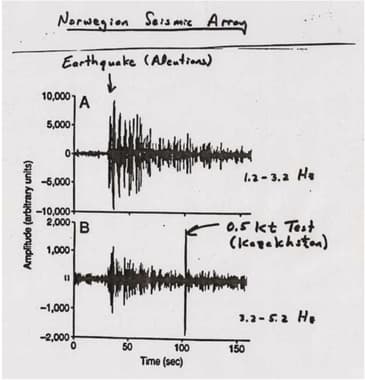
[00:30:45] So in that paper you have this wonderful graph of a seismic signal
[00:30:52] and what is this show?
[00:30:55] Well this was a graph I showed Gorbachev actually.
[00:30:58] It was July 1986.
[00:31:01] Velikov organized an international meeting of scientists
[00:31:05] on the Comprehensive Test Ban Treaty as part of his campaign to keep the moratorium alive.
[00:31:11] And Gorbachev came and Velikov asked me to give a presentation to Gorbachev
[00:31:18] and I showed this presentation that one of the seismologists had given me
[00:31:23] on how much seismology had improved since the 1960s.
[00:31:28] And it showed a seismogram of an earthquake using traditional seismology
[00:31:35] and then they had gone to higher frequencies, recording higher frequencies
[00:31:39] and when you tuned into the higher frequencies you saw a spike in the middle of this earthquake
[00:31:45] and that was a very low yield test at Semipolitan's.
[00:31:50] And I mean it's obvious. I mean it's beautiful and I bet the technology now is even better.
[00:31:57] Yeah, I think the high frequency was a big breakthrough going to higher frequencies
[00:32:02] and that also reduced the impact of the decoupling mechanism that Teller had proposed
[00:32:09] of exploding the bombs in a big cavity to muffle the seismic signal.
[00:32:15] The effectiveness on higher frequencies much less.
[00:32:18] The other thing that's curious to me is that the idea of hiding a nuclear test during an earthquake
[00:32:24] like you don't know when an earthquake is coming so you have to have someone there 24 or 7
[00:32:29] waiting for an earthquake to start and then I mean it's just so ridiculous.
[00:32:35] Well they had other scenarios testing behind the sun and things like that
[00:32:40] to fight the idea of a nuclear test ban.
[00:32:42] Was this the US thinking that's what the Soviets would do?
[00:32:46] Yeah, this was scenarios that Teller's people were making up for how the Soviets could cheat.
[00:32:52] That just they all just seem so ridiculous.
[00:32:55] Yeah, well I mean that shows you the paranoia of the times really
[00:33:00] and the idea that in fact cheating could result in a breakthrough like Teller's X-ray lasers.
[00:33:08] I think that just tells me how much the US was thinking about how they would cheat.
[00:33:14] Well perhaps, yeah.
[00:33:17] Perhaps.
[00:33:19] Because like I wouldn't have thought of any of this but I'm not thinking of cheating.
[00:33:22] Well I think it was mostly to promote paranoia and opposition.
[00:33:26] We would of course comply with any treaty that we signed
[00:33:30] but the Soviets would cheat in any way that they possibly could.
[00:33:34] But it's interesting that it was the Soviets that reached out to you.
[00:33:38] Yeah this was a new Soviet Union
[00:33:40] and they ended up breaking down US skepticism with initiatives like this
[00:33:46] like allowing in-country monitoring and that became the basis.
[00:33:50] In-country monitoring became part of the Comprehensive Test Ban Treaty
[00:33:54] which was finally signed in 1996 although it hasn't,
[00:33:59] US still has not ratified it.
[00:34:01] So the seismic activity was one way to see if someone was cheating.
[00:34:06] What was the other stumbling block to getting the US to trust the Soviets?
[00:34:13] Velikov then started dealing with these issues one by one
[00:34:17] and Tom Karkin was his primary partner in this.
[00:34:20] Tom had been so effective including in getting journalists interested
[00:34:24] and Congress interested.
[00:34:27] In the subsequent year we were fighting the DLD
[00:34:31] over whether we could get Soviets into the United States
[00:34:35] to man the similar setup around the Nevada test site.
[00:34:40] That finally was resolved and we took a bunch of people in Velikov out
[00:34:46] to one of the sites we'd set up in Nevada.
[00:34:49] I say we, by this time this is Scripps Institution of Oceanography,
[00:34:54] this is John Berger.
[00:34:56] John arranges to set off a chemical explosion in Nevada
[00:35:00] near the test site and test the instruments like the Russians did
[00:35:06] like the explosion in Kazakhstan.
[00:35:09] Now coming back I'm on the plane with Velikov
[00:35:12] coming back from Reno.
[00:35:14] We're sitting next to each other and we say,
[00:35:17] okay what are we going to do next?
[00:35:19] At that time in 88 there was a lot of discussion
[00:35:23] by the governments about lowering the number of nuclear weapons on each side
[00:35:28] and the problem with verifying tactical nuclear weapons
[00:35:33] and particularly tactical nuclear weapons on ships,
[00:35:37] surface ships not the SLBMs but the cruise missiles.
[00:35:43] Velikov had been told by the head of the Natski Institute.
[00:35:48] This guy told Velikov he had an instrument
[00:35:51] he could see a nuclear weapon a mile away.
[00:35:54] That was incorrect.
[00:35:57] The guys around Velikov who were working with Von Hippel
[00:36:02] knew that was incorrect.
[00:36:05] There was this group called the Committee of Soviet Scientists
[00:36:10] Against the Global Threat or something like that
[00:36:13] working with FAS, writing papers
[00:36:19] and they were writing a paper about how well you could detect a nuclear weapon,
[00:36:24] how far away and so forth.
[00:36:26] So Velikov was in tune to the issue
[00:36:29] and we agree on the plane,
[00:36:32] okay let's do an experiment with some radiation detectors,
[00:36:36] passive radiation detectors
[00:36:38] to see what the utility of these passive detectors are
[00:36:43] and detecting the presence or absence of nuclear weapons.
[00:36:46] So he goes back to Moscow
[00:36:49] and I start doing research on detectors
[00:36:53] and people to do this work
[00:36:57] and I learned that one of the best detectors you could get
[00:37:01] was made by a company called Princeton Camitech
[00:37:04] and it was a transit germanium detector
[00:37:08] that operates at liquid air temperature
[00:37:12] and so I was ready to buy $70,000 worth of equipment
[00:37:17] and there I was am I going to buy this?
[00:37:20] This is big money for NRDC
[00:37:23] and then the thing falls apart
[00:37:25] so I'm communicating with Velikov facts
[00:37:29] and are we going to have a ship or not?
[00:37:32] I get the word back yes.
[00:37:38] Thank you for listening
[00:37:39] and a special thanks to Tom
[00:37:41] and his many pictures of the Black Sea experiment.
[00:37:44] Thank you for his hospitality at Princeton
[00:37:46] and the Stanley Center for Peace and Security
[00:37:48] for sponsoring this episode.
[00:37:50] You can find more information on the podcast website
[00:37:53] mynuclearlife.com
[00:37:55] Until next time, I'm Shelly Lesher
[00:37:58] and this has been My Nuclear Life.